
Build
Growth needs strong fundamentals. Together, we create structure, consistency and a go-to-market process your whole team will adopt.
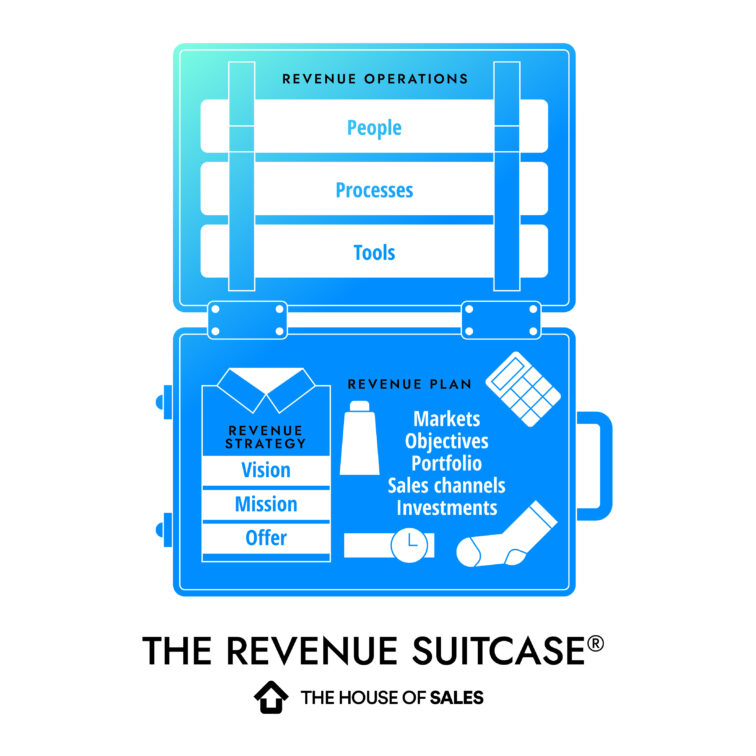
The Revenue Suitcase®
Your Sales toolkit is designed to help you win new customers and close projects faster. It gives you end-to-end control over both your Sales process and your clients’ Buying journey, while ensuring you deliver consistent messaging. After all, control and consistency are the fuel that power your Revenue engine.

True North Navigation
We bring clarity and structure to your Revenue operations. Through standardisation and simplicity, we transform your operations from a cost centre into a profit organisation. This way, your engine runs smoothly and you can steer with precision.

C-shadowing
Access the expertise of a Chief Revenue Officer before you hire one. We provide strategic guidance, challenge your Revenue plans and prioritise your daily Revenue operations.
You ask, we answer
A Revenue of Business plan is about doing the right things right in a particular FY. (e.g. Business plan 202x) At The House of Sales we introduce the MOPSI to get all noses in your company in the same direction. The M stands for Markets or Segmentation. What is your ICP, how many are they, and where are they located? Next, the O refers to Objectives. To get focus, limit yourself to 3, 2 expressed in money and 1 in volume. The P of Portfolio is about the asset(s) to turn over in revenues. Make sure you have a Trojan Horse included to break in early and fast into new clients. The S is about the Sales channels set up to generate those revenues, and finally the I is about the necessary Investments to reach the set objectives
A revenue engine helps you win new customers and projects faster by increasing control over your entire sales process and your customers’ decision-making process, and by sending consistent messages to the market. These are the key drivers that let you accelerate growth – whether you’re hiring salespeople, forming partnerships, or expanding internationally.
Avoid silos between functions in the company. Along the Customer Journey you have Marketing in the lead of the early stages. Then, Sales is converting the MQLs into SQLs, and the SQLs hopefully into wins. Signed contracts are then transferred to Services Delivery and/or Customer Success for onboarding and adoption. Since your Services professionals are grown into Services ambassadors (www.thehouseofservices.com), they’ll identify additional leads and opportunities, and send these back to Marketing or Sales. This way, your Customer Journey becomes a circle with no end. Document the hand-over moments and agree on SLAs between the functions to always provide necessary attention to your customers and keep them on board forever
It depends on 2 criteria: 1. What do you want to measure and 2. When?
First, you have performance metrics such as revenues, net profit, gross margin, ebitda, sales growth vs. last year, # of new customer acquisitions, etc.
Then, you have process metrics like conversion rates (e.g. win/loss), Sales cycle length (e.g. quote-to-close leadtime), pipeline values per stage, where-do-you-lose, etc.
Next, there’s the customer-focus metrics known as customer lifetime value (CLV), customer acquisition cost (CAC), retention or churn rates, net promoter score (NPS), etc.
Finally, you also have individual/team activity metrics IF and only IF the above are falling short …
Pick 3 out of the above list based on your company type of business (e.g. SaaS) and maturity stage
Put conversion rates and lead times along the end-to-end Sales cycle. By doing so and as an example, you’ll be able to predict that 1€ in stage 1 will bring 8 cent after 11 weeks, 1€ in stage 2 will generate 25 cent after 9 weeks, 1€ in stage 3 will already deliver 37,5 cent after 5 weeks and 1€ in stage 4 will finally bring 75 cent in 2 weeks, because your win/loss conversion in stage 4 is 75% and it takes you 2 weeks for handling potential showstoppers, negotiation and closing. The icing on the cake is when you also control the end-to-end Buying cycle by leading each of the stakeholders towards a consensus in your favor.
We’re getting close! This is the professional mission of Bruno. Measure performance, Sales cycle process and customer focus, and keep track of their evolution. Always work on the weakest link(s). By doing so, you get more end-to-end control over the customer journey leading to forecast accuracy and predictable growth